


Agathe's Artisanal vs. Industrial Biscuit Production: A World of Differences In the gourmet world of biscuits, there are two main production methods: artisanal and industrial. Each has its specific characteristics, advantages, and disadvantages. In this context, why have we, at Biscuits Agathe, chosen the artisanal path? Let's take a look behind the scenes at the workshop to understand better. Quality vs. Quantity.
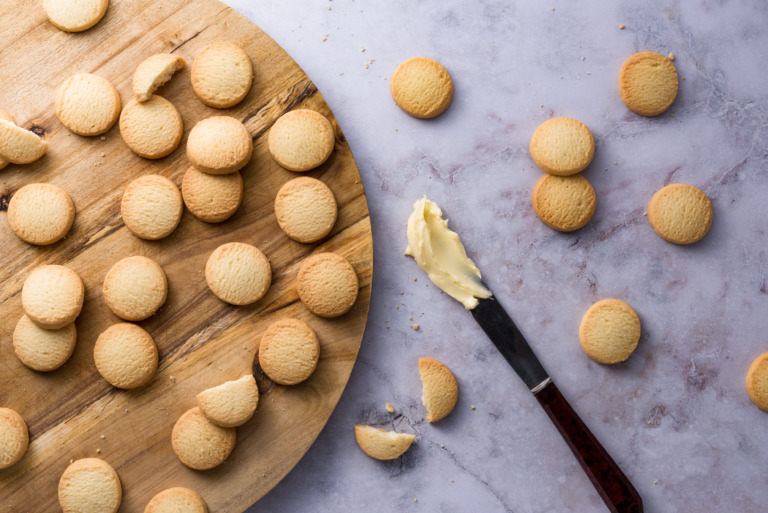
By producing our biscuits artisanally, we can guarantee top quality with every batch. As you already know, we have chosen to work with local ingredient suppliers, which allows us to highlight the authentic taste in our little biscuits. Think, for example, of the melting butter from René Pernet in your Buttery Dorés. You will never find this local flavour in a biscuit made with palm oil.
Unlike us, industrial producers make their biscuits in mass to ensure constant availability on the market, and these tend to have a uniform taste. A Custom Dough for Each Batch Pastry lovers have all noticed it already; ingredients react differently to external factors, such as the season, humidity in the room, or air conditioning. Our assistants strive to manually adapt the recipes to ensure quality in each batch. And it's amazing to see the difference a small egg from Laure Stettler can make when added to a dough weighing over 200 kg!

Large-scale productions often use preservatives, colorants, and artificial flavours to ensure long shelf life and consistent flavour. Look for them in our recipes, you won't find any! Our Assistants Artisanal production prioritizes human expertise. Each biscuit is the result of manual work and carries a story, a gesture, a passion. You only have to observe our workshop manager - Qamil - when he talks about his more than 30 years at Biscuits Agathe. The sparkle in his eye shines brighter with each anecdote, and we feel his pride every time he lets us taste a little biscuit fresh out of the oven. (Are you salivating as much as we are?)

Our Environmental Commitment By choosing to source locally and, whenever possible, in bulk, we drastically reduce our environmental impact. We have also reduced primary packaging waste (i.e., from our ingredients) by more than 90% by implementing an advanced recycling system. This aspect is unfortunately much more complicated for a large-scale production factory to manage, and their impact in terms of water consumption, greenhouse gas emissions, or waste management is often significant. Of course, choosing artisanal production does not only have good aspects. Our production is limited in quantity, and your favourite biscuits may sometimes be out of stock. But rest assured, this also allows us to offer you the freshest possible biscuits. Our production costs are also higher than those of large structures, and this obviously impacts our margin. Without going into too much detail, it's quite an acrobatic feat to combine the costs of quality ingredients and an enthusiastic and qualified team of assistants, while still being able to generate a little extra to fund future recipes. But one thing is certain: we will never compromise on the quality of your small Swiss biscuits. For us, each biscuit is a promise: that of an authentic taste, carefully selected natural ingredients, and expertise passed down from generation to generation. Moreover, as a responsible actor, we are aware of the impact of our decisions on society and the environment. By opting for artisanal production, we reduce our ecological footprint and support the local economy.

While industrial production offers the advantage of quantity and profitability, artisanal production stands out for its authentic character and unparalleled quality. For Agathe and her assistants, the choice of heart and passion was clear from the beginning. A decision reflected in every biscuit we produce, for the greatest pleasure of your taste buds.


